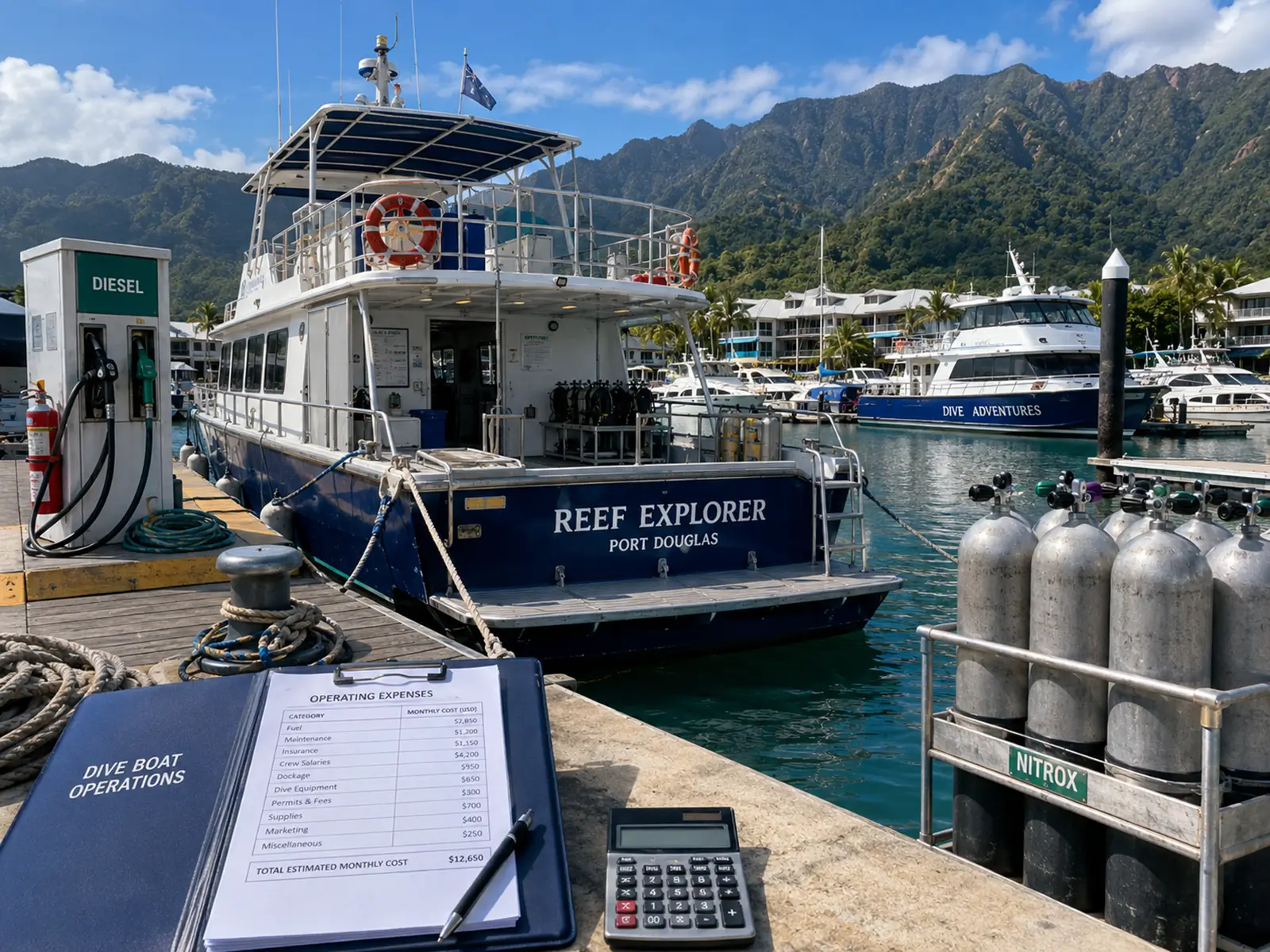
Dive Boat Operating Costs Buyers Should Budget For
A dive boat can be one of the most valuable assets in a scuba business.
It can open access to better dive sites, allow more customers per trip and create a more professional experience. But a dive boat can also become one of the biggest cost centers in the business.
The mistake many buyers make is focusing only on the purchase price.
The real question is not only:
Can I afford to buy this boat?
The better question is:
Can I afford to operate it safely and profitably every month?
On "Dive Listings", buyers can compare dive boats, dive centers and liveaboards, but every boat-based opportunity should be reviewed with operating costs in mind.
If you are still choosing the right vessel, start with "buy a dive boat". If you are looking at a larger multi-day vessel, read "buy a liveaboard". This guide focuses only on the ongoing costs of operating a dive boat.
1. Fuel Costs
Fuel is often one of the biggest daily costs for a dive boat.
The real cost depends on:
- Distance to dive sites
- Engine type
- Boat size and weight
- Sea conditions
- Cruising speed
- Number of trips per day
- Fuel price in the destination
- Whether the boat runs one or two engines
- How fully loaded the boat is
A short local trip may be profitable even with modest pricing. A longer offshore trip may need higher customer prices, minimum passenger numbers or fuel surcharges.
Before buying or operating a dive boat, calculate fuel cost per trip, not only fuel cost per month.
A simple calculation:
Fuel cost per trip = estimated fuel used × local fuel price
Then compare that with expected revenue from the trip.
If fuel costs are too high, a boat can look busy but still produce weak profit.
2. Engine Servicing
Engines need regular servicing, and commercial use can wear them faster than private use.
Budget for:
- Oil changes
- Filters
- Impellers
- Belts
- Spark plugs, if relevant
- Gearbox service
- Cooling system checks
- Propeller checks
- Diagnostics
- Mechanic labor
- Spare parts
The cost depends on the engine type, size, brand, age and local mechanic availability.
A boat with twin engines may offer more redundancy and safety, but it also means two engines to service.
Buyers should ask for service records before purchasing a boat. Missing service history does not always mean the engine is bad, but it increases uncertainty.
A cheap boat with neglected engines can become expensive very quickly.
3. Unexpected Repairs
Every boat needs repairs eventually.
Commercial dive boats are used heavily. They carry divers, tanks, weights, wet equipment and crew. They may operate daily in salt water, sun, waves and wind.
Common repair areas include:
- Engines
- Propellers
- Steering systems
- Electrical systems
- Bilge pumps
- Ladders
- Tank racks
- Seating
- Deck flooring
- Hull repairs
- Navigation equipment
- Fuel systems
- Batteries
- Fresh water systems
- Canopies or shade structures
Buyers should not operate with no repair reserve.
A dive boat that has no maintenance budget can quickly become unsafe, unreliable or unavailable during peak season.
A practical approach is to keep a monthly repair reserve, even during months when nothing breaks.
 |
4. Marina, Mooring or Storage Fees
A dive boat needs a secure place to stay.
Depending on the destination, this may include:
- Marina berth fees
- Mooring fees
- Harbor dues
- Dry storage
- Trailer storage
- Launch fees
- Security fees
- Fresh water charges
- Electricity charges
- Waste disposal fees
In some destinations, marina access can be expensive or difficult to obtain.
Before buying a boat, check whether the current berth or mooring can transfer to you. Do not assume that because the seller keeps the boat somewhere, the new owner can automatically use the same place.
A boat without secure mooring can become difficult or impossible to operate professionally.
5. Crew Costs
A dive boat usually needs more than a captain.
Depending on the size of the boat, trip type and local rules, you may need:
- Captain or skipper
- Deckhand
- Dive guide
- Instructor
- Divemaster
- Boat assistant
- Mechanic support
- Cleaning support
Crew costs may include:
- Salaries
- Freelance payments
- Social security contributions
- Payroll taxes
- Staff insurance
- Meals during trips
- Uniforms
- Training
- Certifications
- Seasonal bonuses
If the owner currently drives the boat personally, buyers should calculate what it would cost to replace that work.
A boat-based business may look profitable only because the owner is doing several jobs without a normal salary.
6. Insurance
Commercial dive boats need proper insurance.
This may include:
- Boat insurance
- Passenger liability insurance
- Public liability insurance
- Professional liability insurance
- Crew insurance
- Equipment insurance
- Third-party liability
- Marina-required insurance
- Environmental liability, depending on location
Insurance costs depend on the country, boat type, passenger capacity, activities, operating area and claims history.
Do not assume the seller’s policy will continue under new ownership.
Before completing a purchase, ask for insurance quotes based on your intended operation.
A boat that cannot be insured properly is not ready for commercial use.
7. Safety Equipment
Safety equipment is not a one-time cost.
It must be purchased, checked, serviced and replaced when needed.
Budget for:
- Life jackets
- Life rafts, if required
- Emergency oxygen
- First aid kits
- Fire extinguishers
- Flares or distress signals
- VHF radio
- GPS
- Navigation lights
- Emergency ladder
- Bilge pumps
- Anchor and lines
- Tool kit
- Spare parts
- Safety signage
- Emergency procedure materials
Some items expire. Some need annual inspection. Some must match passenger capacity and operating area.
For a full safety-focused article, read "dive boat safety and compliance" before making an offer.
 |
8. Inspections, Registration and Permits
A commercial dive boat may need regular inspections and official documents.
Costs may include:
- Boat registration
- Commercial operating certificate
- Passenger capacity certificate
- Safety inspections
- Engine inspections
- Environmental permits
- Harbor permissions
- Marina access permits
- Local tourism or activity permits
- Radio license
- Surveyor fees
- Administrative fees
Rules vary by country and destination.
A boat that is legal for private use may not be legal for paid dive trips.
Before buying, confirm not only that the boat exists and works, but that it can legally operate in the way you plan.
9. Cleaning and Daily Turnaround
Daily cleaning is part of operating a professional dive boat.
This may include:
- Rinsing salt from deck and equipment areas
- Cleaning benches and ladders
- Emptying bins
- Cleaning toilets, if onboard
- Refilling water
- Organizing tanks and gear
- Checking safety equipment
- Preparing the boat for the next trip
Cleaning may seem small, but it takes time and labor.
If the boat runs multiple trips per day, turnaround speed matters.
A poorly cleaned or disorganized boat can damage customer reviews, even if the diving itself is excellent.
10. Tank Handling and Filling Costs
If your dive boat operation includes tanks, there are costs behind every cylinder.
These may include:
- Tank filling
- Compressor operation
- Filter changes
- Air quality tests
- Tank transport
- Tank inspections
- Valve servicing
- Staff time for loading and unloading
- Storage
- Replacement tanks
If the business fills its own tanks, compressor costs become part of the boat operation. If tanks are filled externally, the cost per fill must be included in trip pricing.
Heavy tank handling also affects staff workload.
A boat with poor loading access may increase labor time and fatigue.
11. Marketing and Booking Costs
A dive boat needs customers.
Even if the boat is excellent, it still needs bookings.
Marketing costs may include:
- Website updates
- SEO
- Google Ads
- Social media ads
- Photography
- Video
- Printed materials
- Hotel commissions
- Travel agency commissions
- Booking platform fees
- Email marketing
- Local partnerships
Commission costs can be especially important.
A boat trip sold directly may have a stronger margin than the same trip sold through a high-commission partner.
When calculating profit per trip, include customer acquisition costs, not only fuel and crew.
12. Low-Season Costs
Low season is where many boat budgets fail.
Even when trips are fewer, some costs continue.
These may include:
- Marina fees
- Insurance
- Basic maintenance
- Engine checks
- Staff retainers
- Loan payments
- Registration fees
- Website and booking systems
- Security
- Cleaning
- Storage
A boat may earn strong revenue in high season but still lose money during quiet months if fixed costs are too high.
Before buying, look at the full year, not only the best months.
Ask:
- How many months are profitable?
- How many trips run in low season?
- Are costs reduced when demand drops?
- Can the boat be used for private charters or other activities?
- Is there enough cash reserve for quiet periods?
A boat business needs cash flow planning, not only sales optimism.
13. Break-Even Per Trip
Every operator should know the break-even point per trip.
This means the minimum revenue needed for the trip to cover its direct costs.
Direct trip costs may include:
- Fuel
- Crew
- Tank fills
- Food or drinks
- Park fees
- Marina departure fees
- Booking commissions
- Equipment cost allocation
For example, if a trip costs 400 USD to operate and each diver pays 80 USD, the boat needs at least five paying divers to cover direct trip costs.
But that does not include all monthly overhead.
A stronger calculation also includes a share of insurance, maintenance, marina fees and marketing.
Knowing break-even helps you avoid running trips that look active but lose money.
14. Maintenance Reserve
A maintenance reserve is money set aside for future boat costs.
This is important because boat repairs are often large and irregular.
A business may have several good months with low repair costs, then suddenly face a major engine, hull or safety equipment expense.
A maintenance reserve helps protect cash flow.
It should be treated as a real operating cost, not leftover profit.
If a seller shows profit but has not reserved money for maintenance, the buyer should be careful. The business may be less profitable than it appears.
15. Financing or Loan Payments
If the boat is financed, monthly payments affect cash flow.
Buyers should check:
- Outstanding loan balance
- Monthly payment
- Interest rate
- Final payment
- Whether finance can transfer
- Whether the boat is used as security
- Whether there are early repayment fees
If you are buying the boat separately, your own financing costs must be included in the budget.
A boat may be profitable before loan payments but weak after financing costs.
Do not ignore the cost of capital.
16. Cost Per Guest
A useful way to understand dive boat economics is cost per guest.
This helps compare trip pricing with real operating cost.
Costs to consider:
- Fuel per guest
- Crew per guest
- Tank fill per guest
- Commission per guest
- Food or drink per guest
- Park fees per guest
- Equipment wear per guest
- Maintenance allocation per guest
If the cost per guest is too close to the selling price, the business has little room for profit.
A strong boat operation should have pricing that covers direct costs, contributes to overhead and leaves profit.
 |
17. Bigger Boats Have Bigger Fixed Costs
A bigger boat can carry more customers and generate more revenue per trip.
But it also usually means:
- More fuel
- Higher marina fees
- More crew
- Higher insurance
- Higher maintenance
- More safety equipment
- More complex inspections
- More cleaning
- Larger repair bills
A bigger boat only makes sense if demand is strong enough to fill it regularly.
If the boat runs half empty most of the time, a smaller vessel may be more profitable.
Buyers should match boat size to realistic customer demand, not only peak-season dreams.
18. The Real Monthly Budget
Before buying or operating a dive boat, create a monthly budget.
Include:
- Fuel
- Crew
- Marina or mooring
- Insurance
- Maintenance reserve
- Engine servicing
- Safety equipment
- Cleaning
- Tank filling
- Marketing
- Booking commissions
- Registration and permits
- Repairs
- Loan payments
- Low-season reserve
Then compare that with realistic monthly revenue.
This gives a much clearer picture than looking at the boat purchase price alone.
A dive boat is attractive only if it supports the business financially.
Final Thoughts
Dive boats can create strong opportunities for scuba businesses, but they must be budgeted carefully.
The purchase price is only the beginning.
Real operating costs include fuel, engines, repairs, marina fees, crew, insurance, safety equipment, permits, inspections, tank handling, marketing, low-season costs and maintenance reserves.
A boat that looks affordable may become expensive if fuel use is high, engines are old, marina costs are heavy or repairs are frequent.
A smart buyer calculates the cost per trip, break-even point, monthly overhead and maintenance reserve before making an offer.
The best dive boat is not always the biggest or fastest.
It is the one that can operate safely, legally and profitably in the local market.
Next Steps for Buyers
If you are still choosing the right vessel, start with "buy a dive boat".
If you are considering a multi-day vessel business, read "buy a liveaboard".
Before making an offer, review "dive boat safety and compliance".
If you are comparing a full scuba operation, read "how to buy a dive center".
If you are ready to compare opportunities, browse current "dive boats for sale" on "Dive Listings".
You can also explore more guides in our "Dive Boats & Liveaboards" section.
 |