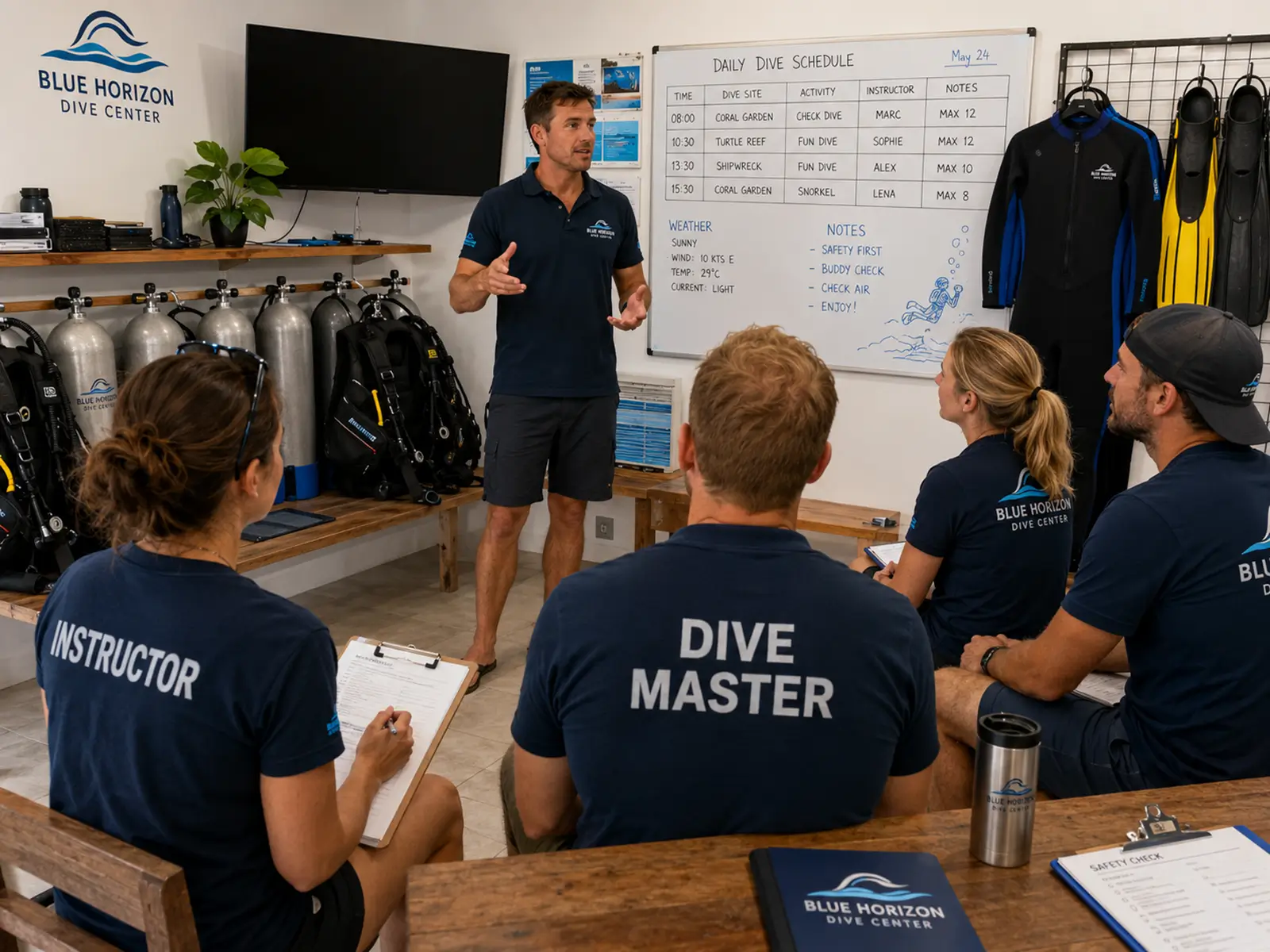
Managing Dive Center Staff and Instructors
A dive center is not only built on equipment, boats, location or dive sites.
It is built on people.
Instructors, divemasters, front-desk staff, boat crew, compressor operators and managers shape the customer experience every day. They influence safety, reviews, course quality, booking flow, daily timing and whether the business can run smoothly without constant owner control.
A beautiful dive center with weak staff can feel chaotic. A simple dive center with a strong team can feel professional, safe and welcoming.
On "Dive Listings", buyers can compare dive centers and scuba businesses for sale, but staff quality is one of the most important things to understand before buying or operating any dive business.
If you are looking at the bigger daily workflow, start with "run a dive center". This article focuses specifically on staff and instructors.
1. Understand the Main Staff Roles
A dive center may look small from the outside, but several roles may be involved in daily operations.
Common roles include:
- Owner or general manager
- Dive center manager
- Instructors
- Divemasters
- Dive guides
- Front-desk staff
- Equipment staff
- Compressor or fill station operator
- Boat skipper
- Deck crew
- Driver
- Sales or booking staff
- Marketing support
- Equipment technician
In a small dive center, one person may handle several roles. In a larger operation, roles may be separated.
The important point is clarity.
Everyone should know what they are responsible for, who makes decisions and who customers should speak to.
When roles are unclear, staff duplicate work, miss tasks or blame each other when something goes wrong.
2. Instructors Are More Than Teachers
Instructors are central to many dive businesses.
They do more than teach courses. They also create trust, calm nervous customers, explain safety, help sell continuing education, guide certified divers, support equipment rental and influence reviews.
A good instructor should be:
- Professional
- Patient
- Safety-focused
- Clear in communication
- Good with beginners
- Organized with paperwork
- Reliable with timing
- Respectful toward customers
- Able to work with the team
- Comfortable with local dive conditions
Technical skill matters, but personality also matters.
Many customers remember how an instructor made them feel. A calm, friendly instructor can turn a nervous beginner into a returning diver.
A rushed or careless instructor can damage the reputation of the entire business.
3. Divemasters and Guides Shape the Fun Dive Experience
Certified divers often spend more time with dive guides and divemasters than with the owner.
These team members affect the quality of guided dives, customer safety and group comfort.
A strong guide should know:
- Local dive sites
- Entry and exit points
- Currents
- Marine life
- Customer ability levels
- Group control
- Air checks
- Navigation
- Emergency procedures
- Environmental rules
A good divemaster does not only lead the group underwater.
They also help before and after the dive, check customer comfort, support equipment setup and notice small problems early.
For many holiday divers, the guide becomes the face of the dive center.
4. Front-Desk Staff Can Protect the Whole Operation
The front desk is often underestimated.
Good front-desk staff can prevent many operational problems before they reach the dive team.
They help manage:
- Bookings
- Payments
- Customer questions
- Certification checks
- Medical forms
- Equipment sizing
- Scheduling
- Walk-ins
- Phone calls
- WhatsApp or email messages
- Course enquiries
- Customer expectations
- Cancellations and rescheduling
A strong front desk keeps the operation organized.
A weak front desk may create overbookings, unclear customer information, wrong equipment sizes, unpaid bookings or confused schedules.
For a deeper article about the customer journey, read "booking and guest flow".

5. Boat Crew and Drivers Matter Too
If the dive center uses boats or transport, boat crew and drivers are part of the customer experience.
A skipper, deckhand or driver may not teach diving, but they affect timing, safety and customer comfort.
They need to understand:
- Departure times
- Loading procedures
- Customer assistance
- Tank handling
- Weather decisions
- Boat safety
- Emergency procedures
- Dive site access
- Customer communication
- Equipment loading and unloading
Customers notice whether boat crew are calm, helpful and professional.
A careless boat experience can damage an otherwise good dive day.
For boat-focused operations, staff quality connects closely with "dive boat safety and compliance".
6. Qualifications Must Be Current and Relevant
Dive center staff should have the right qualifications for their roles.
For instructors and guides, check:
- Certification level
- Teaching status
- Insurance requirements
- First aid training
- Oxygen provider training
- Rescue or emergency training
- Specialty instructor ratings
- Local permits, if required
- Professional membership status
- Recent teaching or guiding experience
For boat crew, check:
- Captain or skipper license
- Commercial vessel qualifications
- Radio license, if required
- Local route knowledge
- Safety training
For compressor operators, check:
- Compressor training
- Fill station procedures
- Air quality awareness
- Tank inspection process
- Emergency shutdown knowledge
A certification card alone is not enough.
The qualification should match the job, the local rules and the real daily responsibility.
7. Languages Can Increase Revenue
In tourist destinations, languages can strongly affect sales and customer confidence.
A dive center may serve customers from several countries. Staff who speak the right languages can improve booking conversion, briefings, course sales and reviews.
Useful languages depend on the market, but may include:
- English
- Spanish
- German
- French
- Italian
- Dutch
- Polish
- Portuguese
- Chinese
- Local language
Language is especially important for beginners and nervous customers.
A customer may book faster when they can ask questions in their own language. They may also feel safer during a briefing or course.
For buyers, the staff language mix should match the destination’s customer base.
8. Scheduling Needs Real Planning
Dive center scheduling can be difficult.
Staff planning must balance customer demand, safety, rest time, course requirements, boat capacity, equipment availability and legal working rules.
A staff schedule should consider:
- Morning and afternoon trips
- Course sessions
- Pool sessions
- Shore dives
- Boat dives
- Private guiding
- Staff days off
- Peak season demand
- Low season reductions
- Instructor specialties
- Language needs
- Experience level of staff
- Emergency backup
Poor scheduling creates stress.
An instructor may be assigned too many tasks. A guide may be rushed between dives. The front desk may promise a course without checking staff availability. A boat may be ready but the assigned instructor may still be finishing another activity.
Good scheduling protects both customers and staff.

9. Avoid Overloading Key People
Many dive centers rely too heavily on one or two strong people.
This may be the owner, a senior instructor, a manager or a local guide.
At first, this can feel efficient. But it creates risk.
Problems appear when that person:
- Gets sick
- Takes holiday
- Leaves the business
- Burns out
- Moves to another destination
- Has a conflict with the owner
- Is unavailable during peak season
A healthy dive center should spread knowledge and responsibility across the team.
The business should not collapse because one person is missing.
For buyers, this is very important. A dive center that depends too much on the current owner or one instructor may be harder to take over.
10. Staff Contracts and Work Arrangements Should Be Clear
Staff arrangements vary widely between destinations.
Some dive centers use full-time employees. Others use seasonal workers, freelancers, commission-based instructors or external boat crew.
Whatever the model, it should be clear and legal.
Buyers and owners should understand:
- Who is employed
- Who is freelance
- Who is seasonal
- Who is full-time
- Who has written contracts
- What each person is paid
- What benefits or obligations exist
- Whether social security or payroll costs apply
- Whether work permits are needed
- Whether staff are likely to stay after sale
Unclear staff arrangements can create legal, financial and operational risk.
If a seller says “the staff will probably stay”, buyers should verify this carefully.
11. Staff Retention Has Business Value
Good staff are hard to replace.
A dive center with stable, experienced staff can be more valuable than one with constant turnover.
Staff retention helps with:
- Customer service
- Safety standards
- Local knowledge
- Team culture
- Course quality
- Repeat customers
- Operational consistency
- Reviews
- Handover after sale
People stay for different reasons.
They may value fair pay, good schedules, respectful management, safe working conditions, professional equipment, staff accommodation, training opportunities or a positive team culture.
Owners should not assume staff will stay only because the destination is beautiful.
A poorly managed dive center in paradise can still lose good people.
12. Training Staff Internally Improves Consistency
Even experienced staff need to learn how a specific dive center operates.
Internal training helps create consistency.
This may include:
- Customer greeting standards
- Check-in process
- Equipment issue process
- Dive briefing format
- Boat loading process
- Emergency procedures
- Review collection
- Course paperwork
- Complaint handling
- Sales process
- Environmental rules
- Local site procedures
The goal is not to turn everyone into robots.
The goal is to make sure customers receive a consistent, professional experience no matter which staff member serves them.
A dive center with written staff procedures is usually easier to manage and easier to sell.

13. Staff Culture Affects Customers
Customers can feel the team atmosphere quickly.
A team that respects each other creates a calm environment. A team with conflict, stress or poor communication creates tension.
Good staff culture includes:
- Clear leadership
- Respectful communication
- Shared safety standards
- No public arguments
- Support for new staff
- Honest feedback
- Fair workload
- Professional behavior around customers
- Pride in the dive center
Bad staff culture can appear in small ways.
Customers may notice staff complaining, blaming each other, rushing, ignoring questions or acting annoyed.
Even if the diving is good, poor team atmosphere can reduce customer confidence.
14. Freelancers Can Help, but They Need Standards
Many dive centers use freelance instructors or guides.
This can be useful during high season, group trips or special courses.
Freelancers can provide flexibility, but they should still follow the dive center’s standards.
Before using freelancers, clarify:
- Certification status
- Insurance
- Local legal requirements
- Pay rate
- Customer responsibility
- Equipment use
- Briefing standards
- Course paperwork
- Safety procedures
- Language ability
- Cancellation expectations
A freelance instructor represents the dive center while working with its customers.
If the freelancer delivers a poor experience, the customer will usually blame the business, not only the individual.
15. Seasonal Staff Need Extra Management
Seasonal dive destinations often hire temporary staff.
This can work well, but seasonal teams need fast onboarding and clear systems.
Seasonal staff should quickly learn:
- Local dive sites
- Customer profile
- Equipment setup
- Daily schedule
- Booking process
- Safety rules
- Boat or shore logistics
- Emergency contacts
- Business standards
- Local environmental rules
Do not assume that an experienced instructor from another destination automatically understands your local operation.
A short onboarding process can prevent mistakes and improve customer experience.
Seasonal staff can be excellent, but they need structure.
16. Owner-Operator vs Manager-Led Business
Some dive centers are owner-operated. Others are manager-led.
Both models can work.
An owner-operated business may feel personal and flexible. Customers may love dealing directly with the owner. But the business may depend heavily on one person.
A manager-led business may be easier to scale and transfer, but it requires stronger systems and reliable leadership.
Buyers should ask:
- What does the owner do every day?
- Who manages staff?
- Who handles bookings?
- Who teaches courses?
- Who solves problems?
- Who holds local relationships?
- Can the business run when the owner is away?
- Is there a second person who understands the full operation?
A business that can operate without the owner for short periods is usually stronger and easier to transfer.
17. Staff Costs Must Be Understood Properly
Staff are not only an operational issue. They are also a major financial factor.
Owners and buyers should understand:
- Salaries
- Freelance payments
- Commission structures
- Payroll taxes
- Social security
- Insurance
- Training costs
- Accommodation support
- Meals
- Uniforms
- Bonuses
- Recruitment costs
- Low-season retainers
A dive center may look profitable if the owner does unpaid work or underpays key staff.
For a realistic view, calculate what it would cost to replace the owner’s labor and retain qualified people.
This connects with "revenue vs profit in dive business valuation", because staff costs can change the real earning power of the business.
18. Customer Reviews Often Reveal Staff Quality
Online reviews can reveal a lot about staff.
Look for repeated mentions of:
- Friendly instructors
- Patient teaching
- Professional guides
- Safe briefings
- Helpful front desk
- Calm boat crew
- Good organization
- Multilingual support
- Personal attention
Also watch for negative patterns:
- Rude staff
- Rushed courses
- Poor communication
- Disorganized check-in
- Unsafe feeling
- Lack of attention
- Confusing instructions
- Bad group management
One bad review may not mean much. Repeated comments show patterns.
For buyers, reviews can help confirm whether the team is a real business strength or a possible weakness.
19. Handover Depends on People
When a dive center is sold, staff can make the transition easier or harder.
A strong team can help the buyer continue operations smoothly.
During handover, the seller should introduce the buyer to:
- Instructors
- Guides
- Front-desk staff
- Boat crew
- Equipment staff
- Compressor operators
- Freelancers
- Local partners
The buyer should understand who is essential, who may leave and who can help with continuity.
A business may lose value if key staff are not willing to stay after the sale.
For sellers, preparing staff carefully can support a smoother sale. For buyers, meeting key staff before completion can reduce risk.
20. What Buyers Should Ask About Staff
Before buying a dive center, ask:
- Who works in the business now?
- What are their roles?
- Are they employees, freelancers or seasonal?
- Are contracts in place?
- Are qualifications current?
- Are staff insured where required?
- Which languages do they speak?
- Who are the key people?
- Who is likely to stay after sale?
- What does the owner currently do?
- Who handles bookings and customer service?
- Who teaches courses?
- Who guides dives?
- Who operates the compressor?
- Are there staff shortages in high season?
- Are there any staff conflicts or pending issues?
Good answers will show whether the team is stable, legal and transferable.
Vague answers may indicate risk.
Final Thoughts
Staff and instructors are at the heart of every dive center.
They affect safety, customer experience, course quality, daily workflow, reviews, revenue and business value.
A strong team can make a dive center easier to manage, easier to grow and easier to transfer to a new owner. A weak or unstable team can create stress, customer complaints, safety risks and hidden costs.
Owners should build clear roles, fair schedules, consistent procedures and a professional team culture.
Buyers should look beyond the equipment and financials. They should understand who actually runs the business day to day, whether key staff will stay and how much the operation depends on the current owner.
A dive center is only as strong as the people who operate it.
Next Steps for Buyers and Operators
To understand the full daily workflow, start with "run a dive center".
To improve customer handling from enquiry to dive day, read "booking and guest flow".
For emergency planning and operational risk, review "safety procedures".
If staff rely heavily on rental gear, read "dive equipment rental fleet".
If you are ready to compare real opportunities, browse current "dive centers for sale" on "Dive Listings".
You can also explore more guides in our "Dive Center Operations" section.