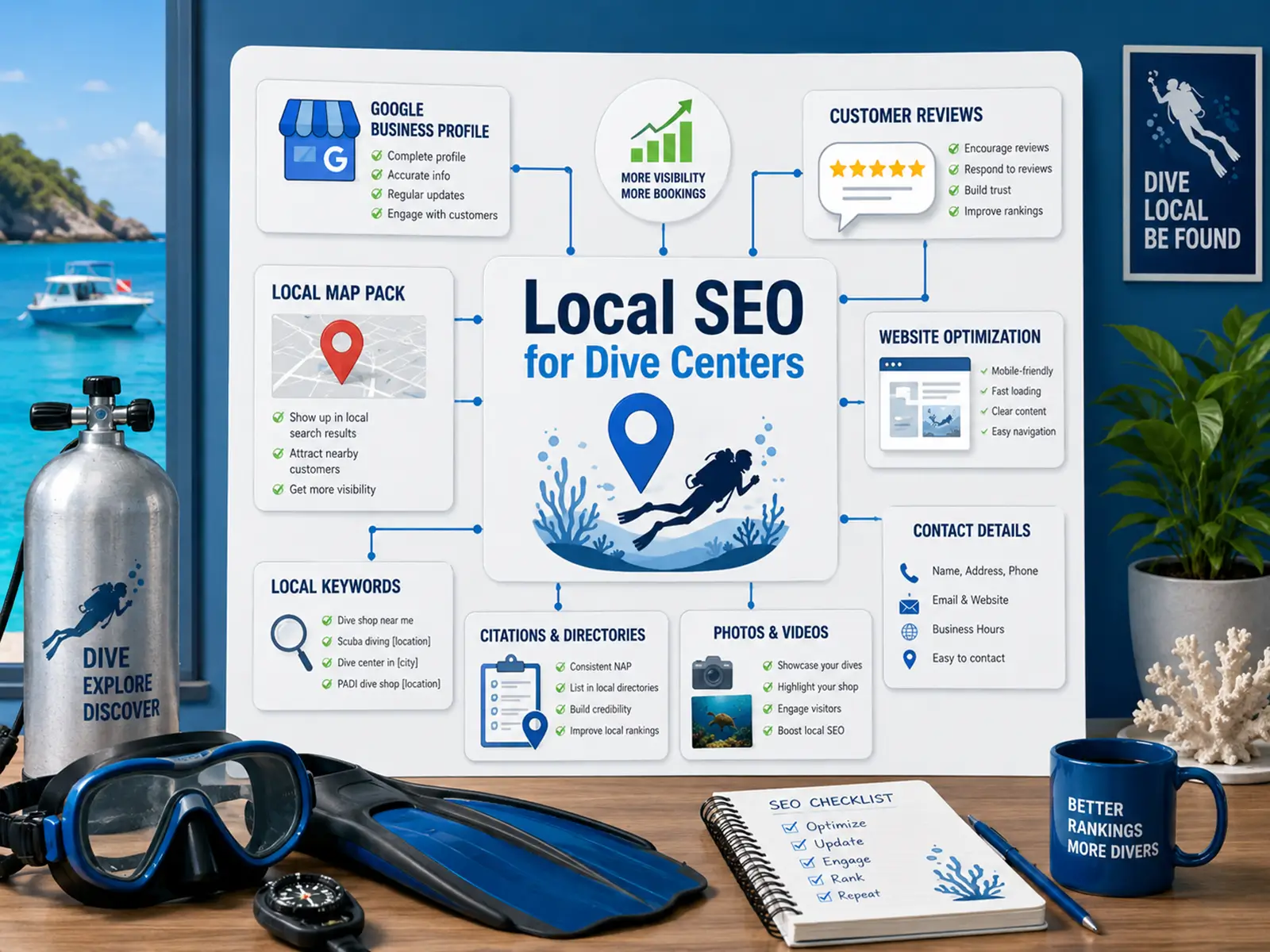
Local SEO for Dive Centers: Rank Better on Google and Maps
Local SEO is one of the most important marketing channels for dive centers.
When people travel to a destination, they often search online before booking an activity. They may search for “scuba diving near me”, “dive center in Tenerife”, “PADI course Malta”, “try dive Lanzarote”, “snorkeling and diving in Cozumel” or similar local phrases.
If your dive center appears clearly in Google Search and Google Maps, you have a better chance of getting direct enquiries and bookings.
Local SEO is not only about ranking for one keyword. It is about helping customers find your business, trust it and contact you at the right moment.
On "Dive Listings", buyers can compare dive centers and scuba businesses for sale, but local SEO is also an important part of business value. A dive center with strong local visibility can be easier to grow and less dependent on paid ads or third-party platforms.
If you want the broader marketing overview, start with "get more dive customers". This guide focuses specifically on local SEO for dive centers.
1. Understand How Customers Search
Dive customers often search with local intent.
They may already know the destination and want to find the best operator nearby.
Common search patterns include:
- scuba diving near me
- dive center near me
- dive center in [destination]
- scuba diving [island]
- PADI course [destination]
- try dive [destination]
- beginner scuba diving [destination]
- best dive center [destination]
- boat dives [destination]
- snorkeling trips [destination]
- wreck diving [destination]
A dive center should understand which activities customers search for and which destination names they use.
For example, customers may search by island, town, beach, marina, resort area or region.
A good SEO strategy should match real customer language, not only technical diving terms.
2. Optimize Your Google Business Profile
For local SEO, the Google Business Profile is essential.
It often appears before the customer visits your website.
A strong profile should include:
- Correct business name
- Accurate address or service area
- Current opening hours
- Phone number
- Website link
- Booking link, if available
- Business category
- Business description
- Fresh photos
- Customer reviews
- Responses to reviews
- Questions and answers
- Updates when needed
The profile should look active and trustworthy.
A customer comparing several dive centers may choose the one with better photos, clearer information, stronger reviews and easier contact options.
Do not treat the profile as something you set once and forget.
It should be maintained regularly.
3. Use the Right Business Categories
Business categories help Google understand what your company does.
A dive center should choose the most relevant primary category available and add suitable secondary categories when appropriate.
The exact options may vary, but the goal is simple:
Google should understand that your business provides scuba diving, training, tours or related services.
Avoid choosing categories only because they seem broad or popular.
The profile should reflect the real business.
If the business offers scuba courses, guided dives, snorkeling trips, boat tours or equipment rental, make sure the profile and website describe those services clearly.
4. Keep Name, Address and Phone Consistent
Local SEO depends partly on consistency.
Your business name, address and phone number should be consistent across:
- Website
- Google Business Profile
- Social media profiles
- Online directories
- Booking platforms
- Hotel partner pages
- Travel websites
- Local tourism listings
Small differences can create confusion.
For example, one listing may show an old phone number, another may show a different address and another may use an old business name.
This can weaken trust and create customer frustration.
A dive center should regularly check its most important online profiles and update incorrect information.

5. Build Strong Destination Pages
A dive center website should have pages that match customer searches.
Instead of having only one generic homepage, the site can include useful pages such as:
- Scuba diving in [destination]
- Try dive in [destination]
- PADI courses in [destination]
- Guided dives in [destination]
- Snorkeling trips in [destination]
- Boat diving in [destination]
- Wreck diving in [destination]
- Dive sites in [destination]
These pages should not be empty keyword pages.
They should help real customers understand the activity.
A good destination page should include:
- Who the activity is for
- What is included
- Price or starting price
- Duration
- Meeting point
- Certification requirements
- Equipment information
- Photos
- FAQs
- Booking button
- Safety or beginner information
Useful pages rank better and convert better.
6. Write for Beginners, Not Only Divers
Many customers searching locally are not experienced divers.
They may be beginners, tourists, families or people trying scuba for the first time.
Your content should answer simple questions:
- Can beginners do this?
- Do I need certification?
- Is it safe?
- How long does it take?
- What should I bring?
- Is equipment included?
- Can children join?
- Do I need to swim well?
- What happens if the weather is bad?
- Can I book today or tomorrow?
Experienced divers may search for specific dive sites or conditions, but beginners need reassurance.
A dive center that explains clearly can win more bookings than one that only uses technical language.
7. Add Local Keywords Naturally
Local keywords should appear naturally on your website.
Useful keyword combinations may include:
- scuba diving + destination
- dive center + destination
- PADI course + destination
- try dive + destination
- snorkeling + destination
- dive trips + destination
- boat dives + destination
- diving school + destination
- beginner diving + destination
Use the destination names customers actually use.
For example, a dive center may need to mention the island, town, beach area, marina and nearby tourist zones.
Do not overuse keywords unnaturally.
Write clear pages for humans first. Search engines should be able to understand the page because the content is useful and specific.
8. Use Photos to Build Local Trust
Photos are very important for dive center SEO and conversion.
Customers want to see the real business.
Useful photos include:
- Dive center exterior
- Reception area
- Equipment area
- Team members
- Boats
- Shore entry points
- Customers preparing gear
- Dive briefings
- Underwater photos from local sites
- Course moments
- Snorkeling trips
- Happy customers after diving
Real local photos help customers trust that the business is active and professional.
Avoid relying only on generic underwater images.
A beautiful reef photo is nice, but customers also want to know where they are going, who will guide them and what the operation looks like.
Add fresh photos regularly to your website and Google Business Profile.

9. Reviews Are a Local SEO Asset
Reviews can influence both visibility and customer trust.
A dive center should actively collect reviews from happy customers.
Good reviews often mention:
- Instructor names
- Safety
- Beginner support
- Good equipment
- Friendly team
- Clear briefings
- Great dive sites
- Professional organization
- Good communication
- Easy booking
These details help future customers understand the experience.
Ask for reviews at the right moment, usually after a successful dive, course or trip.
Make the process simple.
Do not pressure customers or offer misleading incentives.
For a deeper article about reviews and retention, read "repeat divers and reviews".
10. Respond to Reviews Professionally
Responding to reviews shows that the business is active and cares about customers.
For positive reviews, thank the customer personally and mention the experience naturally.
For negative reviews, stay calm and professional.
A good response should:
- Thank the customer for feedback
- Avoid arguing publicly
- Address the issue briefly
- Explain if needed
- Invite private follow-up when appropriate
- Show future customers that the business is responsible
Do not copy and paste the same response to every review.
Personal, professional responses can strengthen trust.
Remember, review responses are not only for the person who wrote the review. They are also for future customers reading them.
11. Create Useful FAQ Content
FAQ sections can help both SEO and conversion.
Dive customers often ask the same questions.
Examples include:
- Do I need experience?
- Can I dive without certification?
- What is the minimum age?
- Is equipment included?
- Do I need to know how to swim?
- What should I bring?
- How long does the activity take?
- Can I dive if I wear glasses?
- What happens if the weather is bad?
- Do you offer hotel pickup?
- Can I book as a family?
- What languages do instructors speak?
Answering these questions on your website can reduce messages and help customers book faster.
Good FAQs also help search engines understand the services you offer.
12. Make Mobile Booking Easy
Many customers search for dive centers on mobile phones.
Your website should work well on mobile.
Check:
- Page speed
- Easy-to-read text
- Clear buttons
- Visible phone or WhatsApp contact
- Simple booking form
- Easy navigation
- Clickable address
- Clear prices
- Fast loading photos
- No broken layout
A customer should not need to pinch, zoom or search for basic information.
If the mobile experience is weak, local SEO traffic may be wasted.
Getting found is only useful if people can actually book.
13. Improve Page Speed
Slow websites lose customers.
This is especially true for tourists using mobile data while traveling.
A dive center website should load quickly and clearly.
Common issues include:
- Very large images
- Too many scripts
- Heavy sliders
- Poor hosting
- Unoptimized video
- Confusing design
- Too many pop-ups
Photos are important, but they should be optimized.
A fast, simple website often converts better than a visually complex site that loads slowly.
Speed matters because customers may compare several dive centers quickly.
14. Use Blog Content Strategically
A blog can support local SEO when it answers real customer questions.
Useful blog topics may include:
- Best dive sites in [destination]
- Beginner scuba diving in [destination]
- What to expect on your first dive
- Best season for diving in [destination]
- Shore diving vs boat diving in [destination]
- Snorkeling and diving options for families
- Marine life you can see in [destination]
- How to choose a dive center in [destination]
Blog content should not be random.
Each article should support a service, destination or customer question.
For dive business owners, content can also build trust before the customer contacts the center.
15. Build Local Links and Mentions
Local links and mentions can help visibility and trust.
A dive center may be listed or mentioned by:
- Hotels
- Resorts
- Tourism boards
- Local activity websites
- Travel blogs
- Marinas
- Conservation groups
- Local guides
- Event pages
- Partner businesses
- Dive clubs
- Local newspapers or magazines
These mentions can send referral traffic and support local authority.
Partnerships can also create real bookings, not only SEO value.
For more detail on this channel, read "hotel and resort partnerships".
16. Create Pages for Different Customer Types
Not every customer wants the same thing.
A dive center can improve SEO and conversion by creating pages for different customer needs.
Examples:
- First-time divers
- Certified divers
- Families
- Cruise passengers
- Private groups
- Advanced divers
- Underwater photographers
- Local residents
- Course students
- Snorkelers
Each page can explain the right activity for that customer type.
For example, cruise passengers may care about timing and transport. Families may care about age limits and safety. Certified divers may care about dive sites and conditions.
Specific pages often convert better than one general page trying to speak to everyone.

17. Keep Information Updated
Outdated information hurts trust.
Regularly check:
- Prices
- Opening hours
- Course availability
- Meeting points
- Phone numbers
- Booking links
- Staff information
- Boat details
- Seasonal schedules
- Cancellation rules
- Photos
- Google profile
- Social media links
A customer who finds outdated prices or wrong opening hours may lose confidence.
Search engines also prefer businesses that appear active and reliable.
A dive center should schedule regular checks of its most important online information.
18. Track What Works
Local SEO should be measured.
A dive center should track:
- Website enquiries
- Booking form submissions
- Phone calls
- WhatsApp clicks
- Google Business Profile views
- Direction requests
- Review growth
- Ranking changes
- Main search terms
- Booking source
- Conversion rate
- Most visited pages
The goal is not to create complicated reports.
The goal is to understand what brings customers.
If many people visit the website but few book, the issue may be conversion. If few people find the website, the issue may be visibility. If customers come from Google Maps but not the website, the profile may be stronger than the site.
Tracking helps owners make better decisions.
19. What Buyers Should Check
If you are buying a dive center, local SEO is part of the business value.
Ask the seller:
- Does the business control its Google Business Profile?
- Are reviews strong and recent?
- How many enquiries come from Google?
- What search terms bring customers?
- Does the website rank for local keywords?
- Are the main pages clear and updated?
- Is the website mobile-friendly?
- Are photos current?
- Are booking links working?
- Are customer sources tracked?
- Are local listings consistent?
- Does the business rely on paid ads or organic visibility?
A dive center with strong local SEO can be more valuable because it has a steady source of direct enquiries.
A business with weak SEO may still be a good opportunity if the buyer can improve visibility after purchase.
20. Local SEO Is a Long-Term Asset
Local SEO is not a one-day task.
It grows over time through consistent improvements.
A strong local SEO system includes:
- Optimized Google Business Profile
- Good reviews
- Clear local service pages
- Destination keywords
- Real photos
- Fast mobile website
- Useful FAQ content
- Local links and mentions
- Updated business information
- Simple booking process
- Tracking and improvement
Unlike paid ads, local SEO can continue bringing customers even when the business is not paying for every click.
That makes it especially valuable for dive centers that want more direct bookings and less dependence on third-party platforms.
Final Thoughts
Local SEO can help dive centers attract customers who are already searching for scuba diving in their destination.
A strong Google Business Profile, good reviews, clear website pages, local keywords, useful photos, FAQ content, mobile booking and consistent business information can all increase trust and visibility.
For owners, improving local SEO can create more direct enquiries and reduce dependence on walk-ins, agencies or paid ads.
For buyers, local SEO shows whether the dive center has a strong digital foundation or room for growth.
The best local SEO strategy is simple: help the right customers find you, understand your offer, trust your team and book easily.
Next Steps for Dive Business Owners
For the broader marketing overview, start with "get more dive customers".
To build offline referral channels, review "hotel and resort partnerships".
To increase reviews and repeat bookings, read "repeat divers and reviews".
To improve the booking journey after customers find you, read "booking and guest flow".
If you are ready to compare real opportunities, browse current "dive centers for sale" on "Dive Listings".
You can also explore more guides in our "Marketing & Growth for Dive Businesses" section.