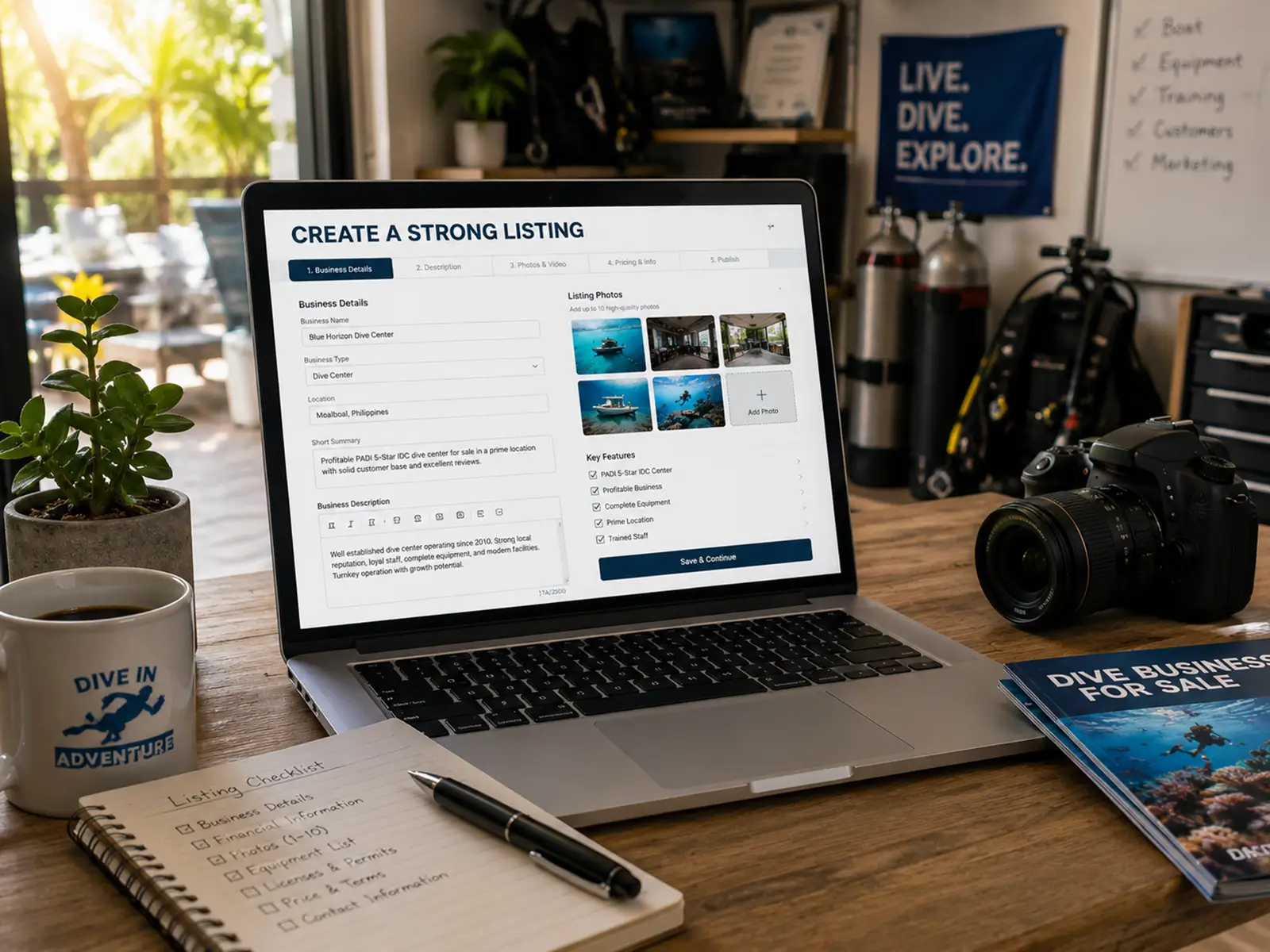
How to Create a Dive Business Listing That Attracts Buyers
A good listing can make the difference between random inquiries and serious buyer interest.
When owners decide to sell a dive center, dive shop, boat-based operation or liveaboard business, the listing is often the first impression a buyer receives. If the listing is vague, too short or poorly presented, buyers may skip it even if the business is good.
On "Dive Listings", sellers can present their dive business to people actively looking for scuba-related opportunities. But to attract the right buyers, the listing must be clear, professional and useful.
If you are still planning the overall process, start with "how to sell a dive center". If your business is not ready to list yet, first read "how to prepare your dive business for sale".
This guide explains how to create a strong dive business listing that attracts serious buyers.
1. Start With a Clear Title
Your listing title should be short, specific and easy to understand.
Avoid vague titles like:
- Great opportunity
- Amazing dive business
- Dream lifestyle for sale
- Profitable business
- Must see
These titles do not tell the buyer enough.
A stronger title should include the business type and location or key selling point.
Examples:
- Established Dive Center in Tenerife
- Turnkey Dive Shop in the Caribbean
- PADI Dive Center in a Tourist Resort
- Boat-Based Dive Operation in Greece
- Liveaboard Business in Southeast Asia
- Dive Center With Strong Online Reviews
The title does not need to include every detail. Its job is to make the right buyer click.
Keep it simple, honest and focused.
2. Write a Strong Opening Summary
The first few lines of the listing are very important.
Buyers want to understand quickly:
- What is being sold
- Where it is located
- What type of business it is
- Why it may be attractive
- Whether it is suitable for their goals
A weak opening sounds like this:
Great dive business for sale in a beautiful location. Huge potential for the right buyer.
A stronger opening sounds like this:
Established dive center for sale in a popular tourist destination, offering guided dives, beginner courses and equipment rental. The sale includes rental equipment, brand assets, online presence and handover support from the current owner.
The second version gives real information. It helps the buyer understand the opportunity immediately.
Do not overpromise. Be specific.
 |
3. Explain the Business Model
A buyer needs to know how the business works.
Your listing should explain the main activities, such as:
- Recreational diving
- Beginner courses
- Certified fun dives
- Boat dives
- Shore dives
- Snorkeling
- Freediving
- Retail sales
- Equipment rental
- Equipment servicing
- Private trips
- Resort or hotel partnerships
- Liveaboard trips
This helps buyers understand whether the business matches their experience and goals.
For example, an instructor may be interested in a training-focused dive school. An investor may prefer a business with a manager and staff already in place. A couple relocating abroad may want a small owner-operated center. An experienced operator may look for a boat-based business with expansion potential.
The clearer your business model is, the easier it is for the right buyer to recognize the opportunity.
4. Describe the Location Properly
Location is one of the biggest selling points for a dive business.
But do not only write “beautiful location” or “great area”. Explain why the location matters.
Useful location details may include:
- Country or region
- Island or coastal area
- Tourist demand
- Diving season
- Nearby hotels or resorts
- Access to dive sites
- Marina or beach access
- Local customer base
- Type of visitors
- Competition level
- Transport connections
You do not always need to show the exact address publicly, especially if the sale is sensitive. But buyers need enough information to understand the market.
For confidential sales, you can describe the region more generally and share exact details later with qualified buyers. For more on this, read "how to sell a dive business confidentially".
5. Be Clear About What Is Included
A buyer should never have to guess what is included in the sale.
Your listing should summarize the main included assets.
Depending on the business, this may include:
- Rental dive equipment
- Tanks
- Compressor
- Boats
- Vehicles
- Retail stock
- Website
- Domain name
- Social media accounts
- Booking system
- Brand name
- Customer database
- Lease rights
- Local partnerships
- Training agency status
- Handover support
You do not need to publish every small item in the public listing, but you should clearly explain the main sale package.
Also mention important exclusions if they could affect buyer expectations.
For example:
Please note: the premises are leased and are not included in the sale.
Or:
The dive boat is available by separate negotiation.
Clear information saves time and prevents misunderstandings later.
 |
6. Add Useful Financial Information
Financial information can increase buyer confidence, but it must be handled carefully.
Some sellers are comfortable publishing revenue or asking price. Others prefer to share details only with qualified buyers.
Useful financial details may include:
- Asking price
- Annual revenue
- Approximate profit
- Cash flow
- Rent level
- Main cost categories
- High and low season pattern
- Revenue sources
- Whether seller financing is possible
- Whether price is negotiable
Do not exaggerate numbers. Do not use unclear claims like “very profitable” without any context.
A stronger version would be:
Financial information is available to qualified buyers after initial contact.
Or:
The business has multiple revenue streams, including courses, guided dives, equipment rental and hotel referrals. Detailed financials are available after buyer qualification.
If you publish numbers, make sure they are accurate and can be supported later.
7. Highlight the Main Strengths
Every listing should explain why the business may be attractive.
Good strengths may include:
- Established brand
- Strong reviews
- Good location
- Repeat customers
- Hotel partnerships
- Well-maintained equipment
- Secure lease
- Experienced staff
- Active website
- Strong social media
- Good booking systems
- Year-round diving
- Low overheads
- Growth potential
- Handover support
Choose the strengths that are actually true for your business.
Do not list everything just to make the listing sound bigger. Buyers trust specific information more than generic selling language.
For example, instead of writing:
Huge potential.
Write:
Growth opportunities include adding online booking, improving SEO, expanding hotel partnerships and introducing new specialty courses.
That is more useful and more believable.
8. Mention Growth Opportunities Realistically
Buyers like growth potential, but they do not like empty hype.
Avoid phrases like:
- Unlimited potential
- Easy to double revenue
- Guaranteed growth
- Massive opportunity
- No competition
Instead, describe practical opportunities.
Examples:
- Add online booking
- Improve website conversion
- Expand multilingual marketing
- Add snorkeling packages
- Build hotel partnerships
- Offer specialty courses
- Increase retail sales
- Add private charters
- Improve social media advertising
- Target certified divers in low season
Good growth opportunities should feel realistic and achievable.
A buyer should think: “I can understand how to improve this business.”
9. Use Strong, Honest Photos
Photos are one of the most important parts of a dive business listing.
Good photos help buyers understand the real business. Poor photos can make even a strong opportunity look weak.
Use clear landscape photos where possible.
Include photos of:
- Exterior of the dive center
- Reception or customer area
- Equipment room
- Training area
- Retail section
- Compressor area, if suitable
- Boats or vehicles
- Dive site access
- Local surroundings
- Team preparing for dives
- Customers or divers, with permission
Do not use only underwater photos. They may look beautiful, but buyers want to see the business they are buying.
Avoid photos with heavy text, logos, watermarks or messy backgrounds. Also avoid showing private contact information directly inside images.
On Dive Listings, the first photo should be the strongest because it will act as the main image.
 |
10. Avoid Contact Details in the Description
The listing description should focus on the business, not direct contact details.
Avoid adding:
- Phone numbers
- Email addresses
- Personal website links
- WhatsApp numbers
- Social media handles
- External contact instructions
Keeping contact inside the platform protects the quality of inquiries and keeps the listing cleaner.
A professional buyer does not need your phone number in the first paragraph. They need a clear business summary and a proper way to make an inquiry.
11. Keep the Structure Easy to Read
A strong listing should be easy to scan.
Use short paragraphs and clear sections. Buyers should be able to understand the opportunity quickly.
A good structure may include:
- Short summary
- Location overview
- Business model
- What is included
- Financial overview
- Key strengths
- Growth opportunities
- Reason for sale
- Handover information
- Confidentiality note, if needed
Avoid one long block of text.
Also avoid writing in all capital letters, using too many exclamation marks or making the listing sound like a social media post.
The tone should be professional, clear and confident.
12. Explain the Reason for Sale
Buyers will always want to know why the business is for sale.
You do not need to include personal details, but a simple explanation helps build trust.
Good examples:
The owner is relocating and is looking for a suitable buyer to continue the business.
The current owner is retiring after many years in the diving industry.
The business is being sold because the owner is focusing on another project.
Avoid creating doubt with unclear language.
For example:
Must sell quickly.
Or:
Owner wants out.
These may attract bargain hunters rather than serious buyers.
A calm, professional reason for sale helps buyers feel more comfortable.
13. Include Handover Support
Handover support can make your listing more attractive, especially for first-time buyers or buyers from another country.
Mention whether you can help with:
- Staff introductions
- Supplier introductions
- Partner introductions
- Booking system training
- Website and account transfer
- Equipment procedures
- Local market knowledge
- Operational training
- Support after completion
This does not mean you must work for the buyer for months. But even a short transition period can increase confidence.
Example:
The owner is willing to provide a structured handover period to introduce the buyer to staff, suppliers and local partners.
That one sentence can make the opportunity feel safer.
14. Be Honest About Buyer Requirements
Some dive businesses are better suited to certain types of buyers.
If your business requires diving qualifications, local language ability, owner involvement or tourism experience, it is better to be clear.
For example:
This opportunity may suit an experienced dive professional or owner-operator who wants to be actively involved in daily operations.
Or:
The business may also suit an investor buyer if a local manager is retained.
This helps filter inquiries and attracts better-matched buyers.
The goal is not to get the most inquiries. The goal is to get the right inquiries.
15. Avoid Common Listing Mistakes
Common mistakes include:
- Title too vague
- No clear location
- No explanation of what is included
- Too much hype
- No business model
- Weak photos
- No reason for sale
- No financial context
- Unrealistic growth claims
- Contact details inside the description
- Too little information for serious buyers
- Too much sensitive information publicly
- Long messy paragraphs
- No mention of handover
A weak listing makes buyers ask basic questions. A strong listing answers many of those questions before the first inquiry.
That saves time for both seller and buyer.
Final Thoughts
A strong dive business listing should be clear, honest and useful.
It should help buyers understand what is being sold, where the business is located, how it operates, what is included, why it may be attractive and what the next step should be.
The best listings do not rely on hype. They rely on specific information.
A serious buyer wants to understand the opportunity quickly. If your listing is organized, professional and realistic, it will stand out from vague or poorly written offers.
Before publishing, ask yourself:
Would a serious buyer understand this business after reading the listing?
If the answer is yes, your listing is already stronger than many others in the market.
Next Steps for Sellers
If you are still planning the sale, start with our guide on "how to sell a dive center".
Before publishing your listing, make sure you have completed the steps in "how to prepare your dive business for sale".
If you need to protect sensitive information, read "how to sell a dive business confidentially".
When you are ready to reach buyers, you can create your listing on "Dive Listings".
You can also explore more guides in our "Selling a Dive Business" section.
 |